One Integration or Many? Rethinking How You Connect Your HRIS to Your Benefits

Organizations already hold most of the data their benefits plan depends on. Salaries, demographics, employment dates, and contact information. It all lives in your HRIS or payroll system. This same data is also required to administer benefits. The trouble is that when the two datasets are managed separately, they drift apart.
This drift is easy to underestimate, because it can remain invisible for a long time. Payroll data stays accurate almost on its own: employees see their pay on every paycheque and flag issues immediately. Benefits data doesn't benefit from this feedback loop. Pun intended. A salary that's out of date in the benefits system can remain this way for months or even years, and no one notices until it matters - often at the time of claim, when, for example, a Long Term Disability payment is calculated on the wrong salary.
Connecting your HR system directly to your benefits system is the obvious fix. Done well, an integration eliminates duplicate data entry, reduces errors, and makes sure enrolments are never missed. But there's a business decision hiding in plain sight that most organizations don't think to consider: what, exactly, do you connect your HRIS to? The answer to this question shapes not just your day-to-day administration, but your flexibility, your exposure to risk, your technology, and your ability to make plan design decisions with your advisor for years to come.
You can connect your HRIS directly to a single insurance carrier, or you can connect it once to Effortless Admin (that sits between your HR system and the entire insurance market). These two approaches may look similar on paper, but in practice, they lead to very different outcomes.
The appeal of a direct HRIS-to-carrier connection
Let's take a look at the traditional approach. Your HR system talks directly to your carrier. Employee data flows over on a schedule. You cut out manual re-keying, and for the benefits your carrier administers, your records and theirs are meant to stay in sync automatically. For an organization that has settled on one carrier and expects to stay there, it can feel like the cleanest possible setup.
There are, however, some challenges organizations often experience with these types of integrations. We'll take a look at four of them. If you have a direct carrier feed today, or are exploring one for the future, these challenges are worth understanding.
Four things we've learned to watch for
1. Feed frequency. Most carrier feeds run weekly or bi-weekly. That sounds minor until you follow it through to a real employee. A life event you process today might not reach the carrier for a week or more. If a new dependent needs a prescription filled before that transfer happens, someone on your team is manually intervening after a claims denial. The feed was supposed to remove manual work. Instead it quietly relocates it.
2. Feed errors. When data doesn't transfer correctly, correcting it can be time-consuming and occasionally costly. And while the error is being resolved, you're back to manual workarounds to make sure the carrier has what it needs. Every workaround is another chance for something to slip through the cracks. Unfortunately, there are times when errors cannot be corrected, resulting in ongoing workarounds.
3. The reconciliation burden. Because of delays, manual intervention, and risk of error, a direct feed requires regular reconciliation to stay trustworthy. This means routinely comparing what's in your HRIS against what's on the carrier's side, then correcting any discrepancies before the monthly bill run. If you track the hours your team spends reconciling, many direct feeds turn out to be far less efficient than they first appeared.
4. Carrier lock-in. This is the one almost nobody talks about, and it can be the most consequential. A direct HRIS-to-carrier integration is, by definition, carrier-specific. You've built a connection to that carrier's system. If it ever becomes in the best interest of your organization and your people to move to a different carrier, you're not just switching insurers, you're rebuilding the integration from scratch. That's a real constraint on your benefits strategy.
None of these are reasons to avoid connecting your data. They're reasons to think carefully about what you connect it to.
If you already have a direct feed
If you're reading this with a direct carrier integration already in place, two practical habits go a long way toward closing the most common gaps:
- Tell your employees how the feed timing works. If life-event changes can take up to a week to appear in the carrier's system, say so. When employees know that, they can plan around it, and they're far less likely to hit a frustrating surprise at the pharmacy or the dentist's office.
- Build a deliberate monthly reconciliation. Work with your carrier and HRIS provider to produce scheduled, consistent reporting you can review before billing closes each month. Catching discrepancies ahead of remittance is dramatically easier than chasing them afterward.
A different approach: connect once, reach the whole market
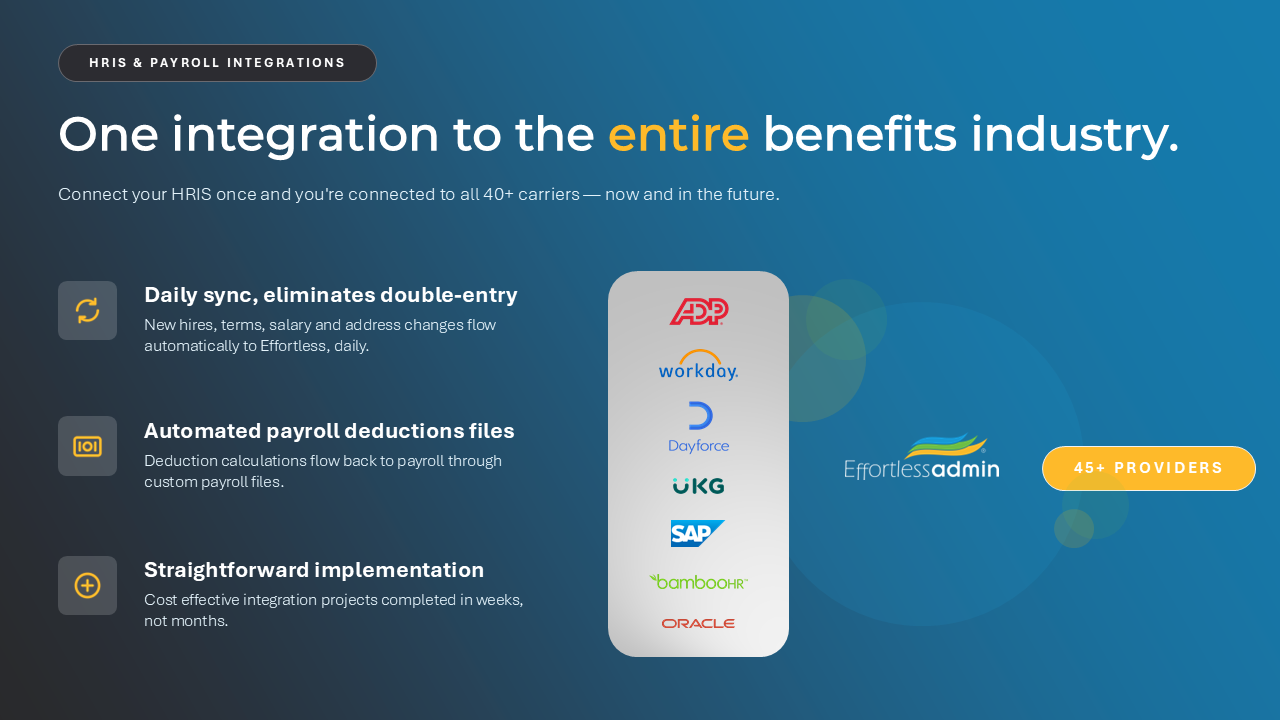
After many years walking alongside employers through these types of challenges, we designed a different integration approach at Effortless Admin. Rather than connecting your HRIS directly to one carrier, we sit in the middle: you connect your HR system to Effortless Admin once, and we connect your data to your carriers. We're already integrated with more than 45 carriers and providers across Canada, so the moment your HRIS is connected to Effortless, you're effectively connected to the entire Canadian insurance market.
A few things we do differently by design:
Our feeds run daily, not weekly. A life event entered today is sent to the carrier the next day, sometimes sooner.
We keep the HRIS integration intentionally minimal. We only pull basic employee information: demographics, salaries, employment dates, and contact details. Everything compliance-sensitive — dependents, beneficiaries, coverage elections — lives inside Effortless Admin, where we can apply our compliance framework on top of it. That framework includes more than 300 rules governing eligibility, flex, non-evidence maximums, overage dependents, beneficiary designations, school confirmations, and more, so a whole category of data errors is prevented at the source rather than caught after the fact.
A dedicated team monitors the data flows. Discrepancies get identified and resolved proactively. Your HR system, meanwhile, stays exactly as it is: no benefits module required.
The loop closes on billing and payroll, too. We consolidate billing across all of your carriers and providers with a last-business-day-of-the-month cutoff, and we produce payroll deduction files that flow back to your finance team.
Why the decision is really about strategy
It's tempting to file HRIS integration under "IT plumbing" and move on. But the choice of what to connect your data to is quietly a benefits-strategy decision. A direct-to-carrier feed ties your operations to one insurer and raises the cost of leaving. Connecting through Effortless Admin, which sits between you and the market, does the opposite: it keeps your data clean, your feeds daily, and your options open.
The underlying principle is one we come back to constantly: clean data leads to clean processes. When the right information reaches the right systems at the right time, the compliance work, the billing, and the employee experience all fall into place behind it. When it doesn't, everything downstream inherits the problem. An integration should make that easier and it should leave your choices open, not close them off.